PRELIMINARY PROGRAM
Download the Full Conference Programme.
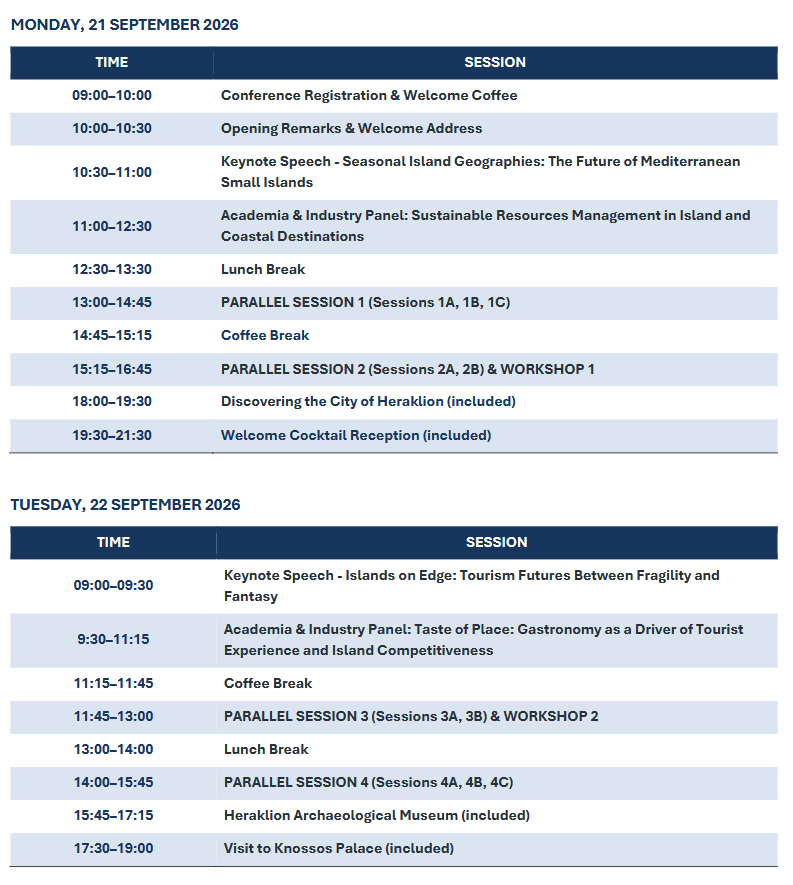
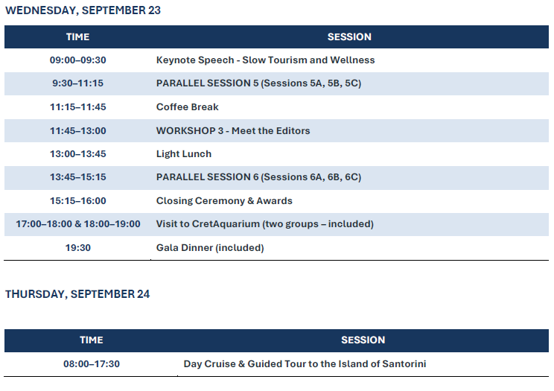
Please find below the Program Overview, along with details of the Workshops and the ‘Meet the Editors’ session.
PROGRAM OVERVIEW
WORKSHOPS & MEET THE EDITORS SESSION
Scientific Coordinator: Ms Afroditi Markaki, PhD(c), Department of Business Administration and Tourism, Hellenic Mediterranean University.
Suggested Format: In-person delivery, up to 10 participants.
Duration: 1.5 hours
Description: Conflict is unavoidable in tourism workplaces, where diverse teams, demanding service encounters, seasonality and resource constraints often intensify interpersonal tensions. This workshop equips participants with practical tools to recognise, understand and constructively manage workplace conflict. Through brief conceptual inputs, and guided reflection, participants will explore common sources and types of conflict, identify their preferred conflict-management style, and examine how thoughts and emotions shape behavioural responses. They will practise active listening, closed-loop communication, assertive “I” messages, empathy and collaborative problem solving. Emphasis will be placed on selecting an appropriate response according to the situation rather than treating one style as universally effective. Participants will leave with a practical framework for addressing disagreements respectfully, protecting employee well-being and strengthening teamwork and service quality in island and coastal tourism organisations.
Requirements: No prior knowledge or experience in the subject area is required.
Scientific Coordinator: Dr. George Kritsotakis, Associate Professor, Department of Business Administration and Tourism, Hellenic Mediterranean University.
Suggested Format: In-person delivery, up to 10 participants.
Duration: 2 hours
Description: The seminar focuses on accessibility and accessible tourism, examining the four core principles that underpin inclusive tourism practices and their application in professional and organizational contexts. It explores the impact of demographic change and population ageing, the importance of understanding different types of disabilities, and the key concepts of impairment, disability, and handicap as essential knowledge areas for tourism professionals. The seminar presents the main models of disability, including the medical and social models, with particular emphasis on neurodiversity and invisible disabilities, fostering awareness and competence in inclusive service delivery. It further examines environmental barriers and social attitudes, highlighting the role of reasonable accommodations within the framework of the purple economy and their relevance to service quality and customer experience. The program also includes good practices from multiple global and regional contexts, insights from the recent SETE study on accessibility in Greece, and an introduction to ISO Standard 21902. Finally, it addresses accessible marketing and provides practical, skills-oriented guidance on creating a welcoming and inclusive tourism environment that benefits both visitors and local communities.
Target Audience: The seminar is designed for every individual in the tourism industry who wish to understand the basic principles and necessity of accessible tourism within the context of sustainable development.
Requirements: No prior knowledge or experience in the subject area is required.
It takes a Village: The Collaborative Chaos of academic writing, reviewing, editing
Ever worried how to move from doing research to actually seeing it published? Ever wondered what really happens between “manuscript submitted” and “paper published”? This interactive workshop pulls back the curtain on academic publishing — from the author’s sleepless nights before submission, to the reviewer’s red pen, to the editor’s impossible balancing act. Expect real talk on rejection, R&Rs, and the messy human side of peer review — plus a hands-on exercise where you’ll step into each role yourself. Whether you’re a PhD student, early-career researcher, or seasoned reviewer, you’ll leave with a sharper eye for writing, reviewing, and surviving the cycle.
Dr. Stella Kladou is an Assistant Professor at the Department of Business Administration & Tourism, Hellenic Mediterranean University, Greece and a Visiting Fellow at Sheffield Hallam University, UK. Her academic and research experience developed mostly in Türkiye, the UK, and Italy, and with other international partners. She is the co-editor in chief of Services Marketing Quarterly, associate editor for the Journal of Food-service Business Research and in the editorial review board of Annals of Tourism Research, Journal of Destination Marketing & Management, Anatolia: An interdisciplinary Journal and the Journal of Hospitality and Tourism Horizons. She has published in prominent academic journals, co-edited and published in books of international publishers (e.g.CABI, Edward Elgar, Emerald, Springer). Her research mainly pertains to place and destination branding and cultural and wine tourism.
Professor Chin-Ee Ong is Professor of Cultural and Tourism Management at the Macao University of Tourism (UTM) and the Editor-in-Chief of Tourist Studies, a leading international peer-reviewed journal. A prominent tourism and cultural geographer with a PhD from the University of Waikato, his research critically examines heritage spaces, state power, and cultural consumption, featuring widely in top-tier journals, UNESCO manuals, and books like Cultural Tourism (Routledge, 2026). Beyond his chief editorship, he serves on multiple editorial boards and acts as the Asia Coordinator for the Association for Tourism and Leisure Education and Research (ATLAS). Having previously taught at the National University of Singapore and Wageningen University, Professor Ong brings a wealth of international expertise to help authors navigate the academic publishing landscape.